
Customer Agent actions now automatically include the visitor's verified email in API requests
Friday, October 30, 2026
What it is
Customer agent now adds the visitor's verified email to outgoing API requests for actions that have email protection turned on.
Why it matters
Actions that call your APIs need a reliable way to identify the visitor. Customer agent now sends the verified email with each eligible request, so you no longer have to ask visitors for it or build custom middleware to pass it along. Your systems can use the email as a lookup key and return the right visitor's data, such as order details.
The Take
We're logged into the system and knows who we are.
Madelyn asked the right question first: “This sounds like something that I would have thought already happened. But am I wrong?” I get why it reads that way. The change is small and the behavior feels obvious. Per the panel, Customer agent now adds the visitor's verified email to outgoing API requests for actions that have email protection turned on, and the panel lists it for Professional and Enterprise.
What it fixes is the part that made the agent feel like a stranger. When the example is order details, I go straight to logged-in portals as the use case. Before, the customer agent had to ask for the email address during the conversation. That is not the worst thing, since it works as a verification. But think about Amazon: “We don't have to give those details. Like it knows us. We're logged into the system and knows who we are.” If a visitor has already identified themselves, I want the agent to stop asking, unless there is a real reason like two-factor authentication.
Casey brought the counterpoint from the marketing side, and it is a fair one. You can pre-fill form fields from known cookie contacts, and she has still kept “a confirm email address field because there are instances where the email address is wrong.” Her point was that it cuts both ways: if someone said keep me logged in and you then ask for their email, that is potentially annoying. I agree there is a real tradeoff there. My read is that agents will get better at telling when something does not sound like the person they think they are talking to, and ask directly when it does not.
The thing I would hold in my head is that cookie-based and logged into a portal are two different situations, and “one's more fragile than the other.” The panel says the email is sent for eligible requests on actions with email protection on, and I would not assume more than that. If a visitor never accepts cookies, I would expect the agent to still ask for the email every time. Maybe that is the way you want it, but know that going in.
What to do: if you run Customer agent with actions that call your own APIs, check which of those actions have email protection turned on, and confirm your order or account lookup can take the email as the key. Then remove any step where the agent asks the visitor to type it. If you have not built actions that call your APIs, or your visitors are not logged in, skip this one for now and watch whether the agent still asks for the email in your own test conversations.
Watch Us Discuss This
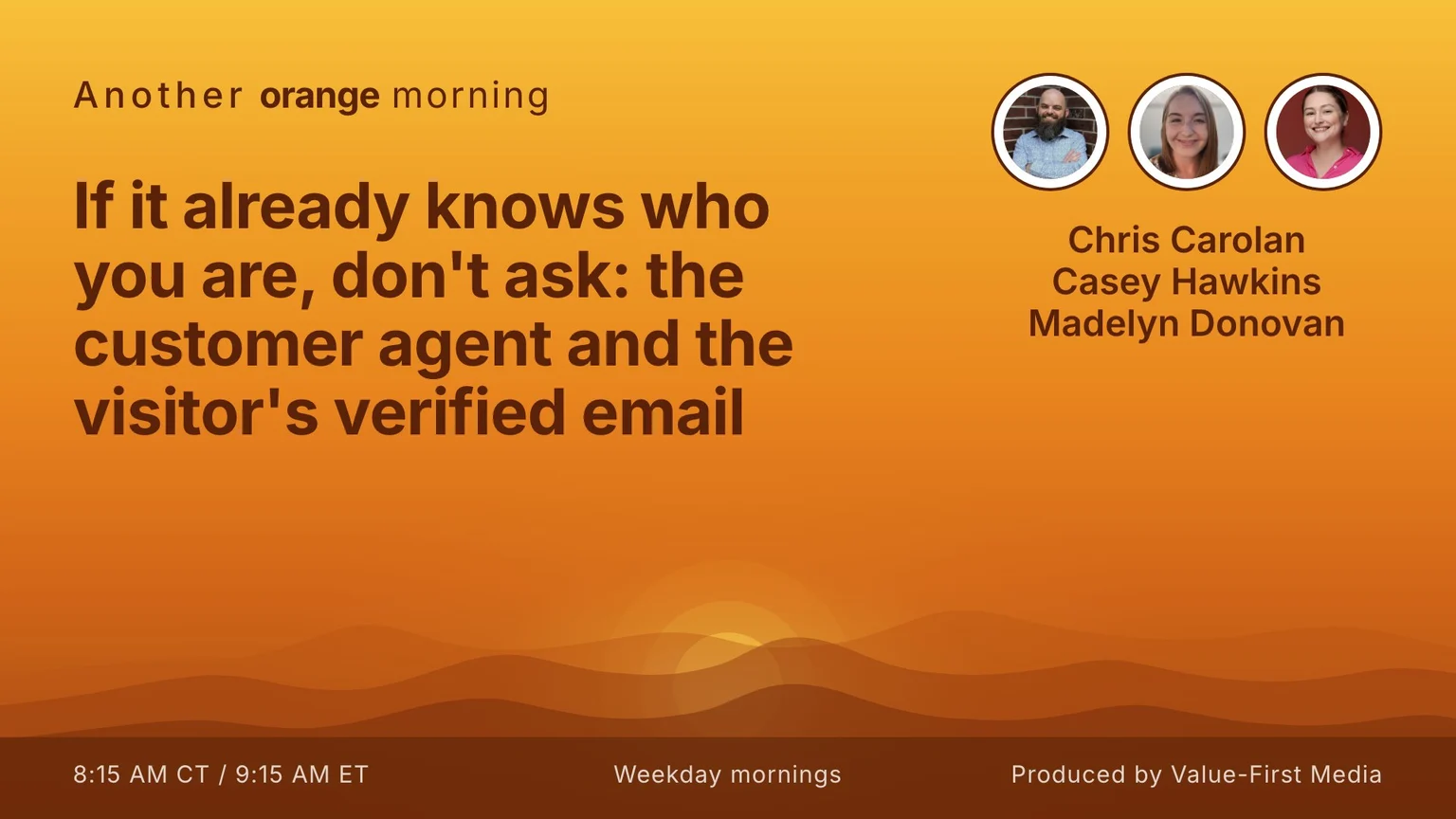
The full segment from the show, us working through this update start to finish.
FAQ
What shipped?
Per the panel, Customer agent now adds the visitor's verified email to outgoing API requests for actions that have email protection turned on.
Why does it matter?
Per the panel, actions that call your APIs need a reliable way to identify the visitor. Customer agent now sends the verified email with each eligible request, so you no longer have to ask visitors for it or build custom middleware to pass it along. Your systems can use the email as a lookup key and return the right visitor's data, such as order details.
Who gets it?
The panel says Customer agent is available for Professional and Enterprise customers. The request only includes the email for actions that have email protection turned on.
What did the hosts make of it on air?
Madelyn thought it sounded like something that had already happened. Chris read it as the logged-in portal case, where the customer should not have to identify themselves again. Casey pointed out that marketing forms can pre-fill from known cookie contacts but she still keeps a confirm email address field, so asking again can be annoying or can catch a wrong address. Chris noted that cookie-based and logged-in identification differ in how fragile they are, and a visitor who never accepts cookies will be asked for their email every time.
Produced by Value-First Media