
From the show
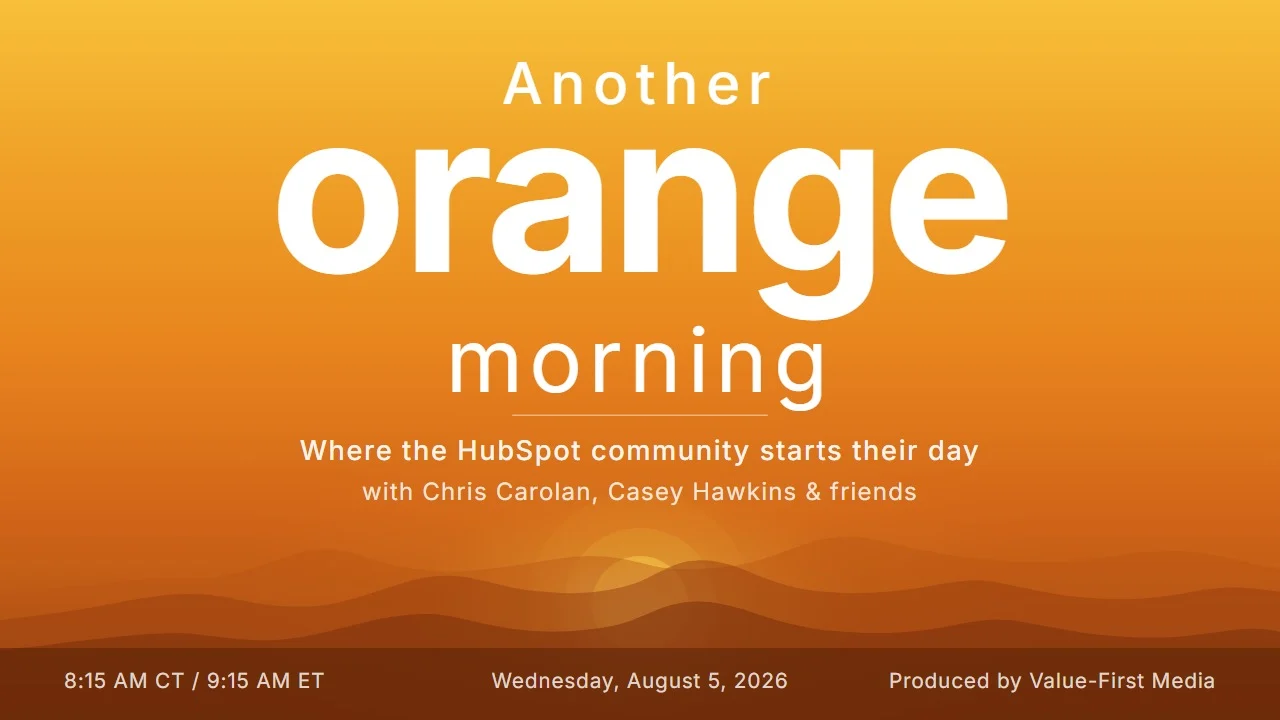
Another Orange Morning Recap: August 5, 2026
Casey was back on a Wednesday for the first time in a while, Zach Hussion was in the Friend seat, and the show opened on the least productive topic available: the theme song. Zach admitted he downloads the video every morning, accidentally opened one in Apple Music, and has since added the song to his driving playlist. His kids have opinions about this. From there the conversation turned to whether anyone could be commissioned to perform it live at Unbound, and whether Dharmesh could be talked into using it as walk-on music.
Here is what we got into: a new coaching opportunity that fires on a low CX score and the question of who the coaching is actually for, Reddit joining the ads reporting lineup, a meeting scheduler update that is not the page you are picturing, a quality assurance score for help desk tickets that got the deepest read of the morning, and the new HubSpot homepage that showed up in the portal mid-show.
The Show Has A Paper Trail Now
Before the updates, a short beat about the site. Recap articles, per-update pages, and clips from last week are all live at anotherorangemorning.com, which means anyone who cannot make the live show can still catch up on what was covered. Zach's clips from the previous week were called out specifically.
This produced the first honest laugh of the episode. Zach's reaction to learning his segments are being cut into clips was to wonder aloud whether he needs to be more self-aware about what comes out of his mouth, since the agents are going to run wild and there may be some mildly inappropriate moments waiting out of context. He is not the first person on this show to have that realization. Casey has already had the experience of pulling up a page, reading a quote, asking whether she really said that, and being told yes.
Customer Agent: New Coaching Opportunity For A Low CX Score
A low CX score coaching opportunity surfaces when a customer agent conversation scores below a set threshold on HubSpot's CX score, the AI model that rates the quality of every conversation. When a conversation lands in the critical or needs review range, it gets flagged in the coaching opportunities panel for an admin to review and act on.
The number that anchored the segment: only about three and a half percent of tickets get a survey response, and the responses that do come back often reflect how the customer felt about the situation rather than how the agent performed. CX score evaluates every conversation automatically, which catches poor outcomes before a survey is ever sent and covers interactions that would never have produced feedback at all.
The conversation immediately connected this to the CX score signals update from the week before, which the show pulled back up on screen. That earlier update calculates a score for each support ticket, and the interesting move here is that the model is now running on customer agent conversations rather than tickets alone. That was the exact wish from the earlier segment: stop confining scoring to ticket scenarios and let it read any conversation that happens in the portal. Getting it days later was a good week for anyone who had been asking.
One observation carried over from the earlier read and held up on the second look. The list of negative signals is long and the list of positive signals is short. There is a case that a few more positive factors would balance it, though there is also a limit to what anyone is actually looking for from a support interaction. Did you show up, were you pleasant, did you answer the question and get to a resolution, and did you go about it like you cared. Miss one of those and the negative side does the work on its own, because people have very little patience, plenty of options, and the ability to broadcast their feelings with one click.
Why it matters: The best part of this segment was the question of who the coaching is for. The obvious reading is that the agent gets coached. The better reading is that the coaching opportunity belongs to whoever controls the agent's settings and the context it was given. A low score is more often a sign that the human has more work to do on the context and the knowledge sources than a sign that the agent had an off day. The panel even points that direction: the recommended actions are adding a short answer, adjusting guidelines, or updating knowledge sources. Not one of them asks whether the AI is good enough. If a lot of bad scores are stacking up, that is the signal to hit pause before rolling further down the track. Read the score as feedback on your setup, not as a performance review of the agent.
For more details: the low CX score coaching opportunity, and the CX score update underneath it.
Reddit Ads Integration
You can now connect a Reddit ads account to HubSpot to see Reddit ad reporting, attribution, and workflow enrollment alongside the other ad channels. This one is in private beta.
Previously there was no way to see Reddit spend next to the rest of the channels, tie it to contacts and deals, or use it to trigger follow-up in HubSpot. Connecting the account brings that data into the same ads workflow already running for the other networks.
Why it matters: This lands two days after Microsoft Ads showed up the same way, and the pattern is the real story. For a very long time the ads reporting supported Meta, Google, and LinkedIn and nothing else. The reporting itself is useful and answers a lot of the questions people actually have, but it was incomplete often enough that clients were pushed back out to Power BI or a tool like Funnel.io to roll everything up. Years of work went into rebuilding reports externally that come out of the box once all the networks are connected. This is HubSpot going deeper on a capability it already had rather than adding a new one, which is what they said they would do. The remaining gap named on the show was ABM platforms; if ads are running through one of those, external reporting is still the answer.
For more details: the Reddit ads integration, and the Microsoft Ads integration that set up this pattern.
Customize Meeting Scheduler In The CRM
This one carried a major update tag, which set expectations higher than the feature delivers. You can customize the meeting create form in the CRM, choosing which properties appear when booking a meeting and which are required before scheduling can proceed.
Today that form is the same for every portal. Customizing it means adding custom meeting properties to be set at the time of booking, making a field required, and getting the data onto the meeting without going back into the meetings index page to fix properties after the fact.
Why it matters: Read the name carefully, because the disappointment in the room was real and it was about naming, not about the feature. This is the meeting create form inside a record, reached by a button most people have never pressed. It is not the public meetings scheduler page, which is a different thing with a nearly identical name and one extra letter. The show went through this same confusion yesterday. Taken for what it is, there is a reasonable use case: a BDR booking on an account executive's behalf who keeps missing steps or information can be required to capture it at the moment of booking. What it does not solve is the actual hard part of scheduling, which is the back and forth about what day and time works. The scheduling link still wins that, and has for hundreds of meetings. The hope worth holding is that flexibility on this side eventually shows up on the other side, especially now that meetings and calls are being untangled from each other.
For more details: the customize meeting scheduler in the CRM update.
Quality Assurance Score For Help Desk Tickets
This one was not on anyone's product updates list, which made it the find of the morning and got the longest run of the show. Quality assurance for support teams is the practice of monitoring, evaluating, and improving the quality of interactions between support reps and customers, assessing real calls, chats, and emails against defined criteria. The stated goals are consistent service, better agent performance through targeted coaching, identifying systemic issues in processes or products, and higher customer satisfaction. The pitch is moving past subjective judgment and random sampling toward a culture of continuous improvement.
Mechanically, QA scoring is enabled or disabled at the portal level from Help Desk settings, and you can define conditions for tickets that should never be scored. What you get back is an overall communication score plus tone, clarity, and empathy scores. The list is what it is; there was no obvious way to define your own categories.
Zach carried this segment, and he came at it from manufacturing quality management systems, which turned out to be the right lens. His first question was whether the guidelines are ours to set. If part of a real process is following up five days after parts ship, does the system know that, or is it scoring tone and empathy against a definition somebody else wrote? That distinction is the whole thing. It also puts QA score and CX score in the same conversation, since tone, clarity, and empathy would plausibly sit inside a customer experience score too. The prediction on the show was that all of this converges into one scoring layer that can be pointed at different objects.
Why it matters: Two takes came out of this and both are worth carrying. The first is about gameability. We have not been good at building measurement systems that resist being played. Award points for closed tickets and you will get closed tickets, whatever that costs the customer. Putting the evaluation in the hands of AI is the better answer, but it does not remove the risk, it moves it. The more deeply people understand how the scoring works, the more they learn the magic words that flag the model a certain way. There is a management judgment here about how much of the mechanism to publish. An update that aims at a culture of continuous improvement can turn into a culture of covering yourself very quickly.
The second take: tie it to revenue. Great scores while revenue moves the wrong way is a finding. Bad scores while revenue climbs is also a finding. The interesting version is the agent noticing which behaviors move the needle and what that does to deal velocity, deal size, and the business. The harder version is causation. A leader who walks the floor already feels whether the team is doing well; the disconnect starts when a board wants it on a dashboard. There is a real prize on the other side of it. When people are not stressed out of their minds every day, when the systems are not broken and AI is carrying the load, they show up happier, and the tone and empathy scores follow. Being able to show that the time savings from an AI implementation turned into less anxious people and a measurable empathy trend is a story very few businesses can currently tell. It is also worth remembering these are quantitative numbers built on qualitative judgment. If you are going to put them in front of leadership, know how the quantification was built before you have to defend it.
For more details: the quality assurance score for help desk tickets update, and the CX score update it keeps bumping into.
The New HubSpot Homepage Showed Up Mid-Show
The last segment happened live. The new HubSpot homepage had appeared in the portal that morning, prompting an invitation to connect an inbox and calendar to start prepping for meetings, catch conversations before they are missed, and organize the day. While the tab sat open on screen, a notice appeared that new feed content was available, timestamped five minutes earlier, with a refresh button and a set of tasks to start from.
There was a light warning about getting too attached to that refresh button. The intent is not a page anyone sits and reloads. It is a tab that stays open the way a calendar or an inbox stays open, that tells you what you need and what to do next, and makes doing that thing easy.
The infrastructure point underneath it was the sharpest observation of the segment. Keeping something like this current is one of the hard parts of building with AI, because the answer to whether it can update every minute is usually yes while the cost of doing so is not incidental. HubSpot carries those costs too, but spread across a customer base that size it becomes additive rather than prohibitive. That is a thing a platform can do for you that you would struggle to build for yourself.
Why it matters: The problem being solved is the five minutes spent searching several systems and thinking hard about what to do next, when the truth is that most of us are really waiting for the next email so we can go react to it, and whatever plan we started the day with gets smashed anyway. A surface that answers what needs doing right now is worth more than it sounds. This is part of the wider redesign heading to everyone, so if it has not landed in your portal yet, it will.
For more details: the redesigned HubSpot Home and its daily feed.
The Sign-Off
Unbound is close, and the running joke is that every year brings the same moment of walking in and asking what HubSpot this is now. If that question hits you between now and then, the answer to give is agentic customer platform HubSpot. That is what HubSpot says it is, and whether or not the phrase means much to you yet, it is clear that they are not describing an intention. They are describing something they are already doing, in a lot of different places at once.
The part worth sitting with is what that does for smaller companies. Knowing how to use these tools is turning into a real competitive edge, the kind that lets a small and agile team compete with much bigger ones without adding headcount to do it. That is not an argument for cutting people. It is an argument that the playing field is leveling, and that is worth being excited about.
You probably already own the value you are looking for in HubSpot. You just need to wake up to it. We will see you tomorrow morning.
Produced by Value-First Media